
Desk story / Crypto Gambling
How Anti-Money-Laundering Rules Apply to Crypto Gambling
The casino floor has no windows. The light is constant. The temperature is 72 degrees. These aren't accidents. They're design. And AML works the same way.
- Filed
- Byline
- Nina Frost
- Length
- 815 words, about 4 minutes
- Copy ID
- SM365-6FB60275
A casino is a machine for controlling attention and behavior. The architect designs for flow. Players enter, they move toward games, they lose money, they leave. The whole sequence is architected: ceiling height, carpet pattern, sight lines, sound design. Even the absence of clocks is deliberate.
Anti-Money-Laundering rules are the same thing, just applied to capital flow instead of foot traffic. The goal is to channel money through a system where the house sees everything. No blind spots. No flow that isn't accounted for.
The AML Architecture
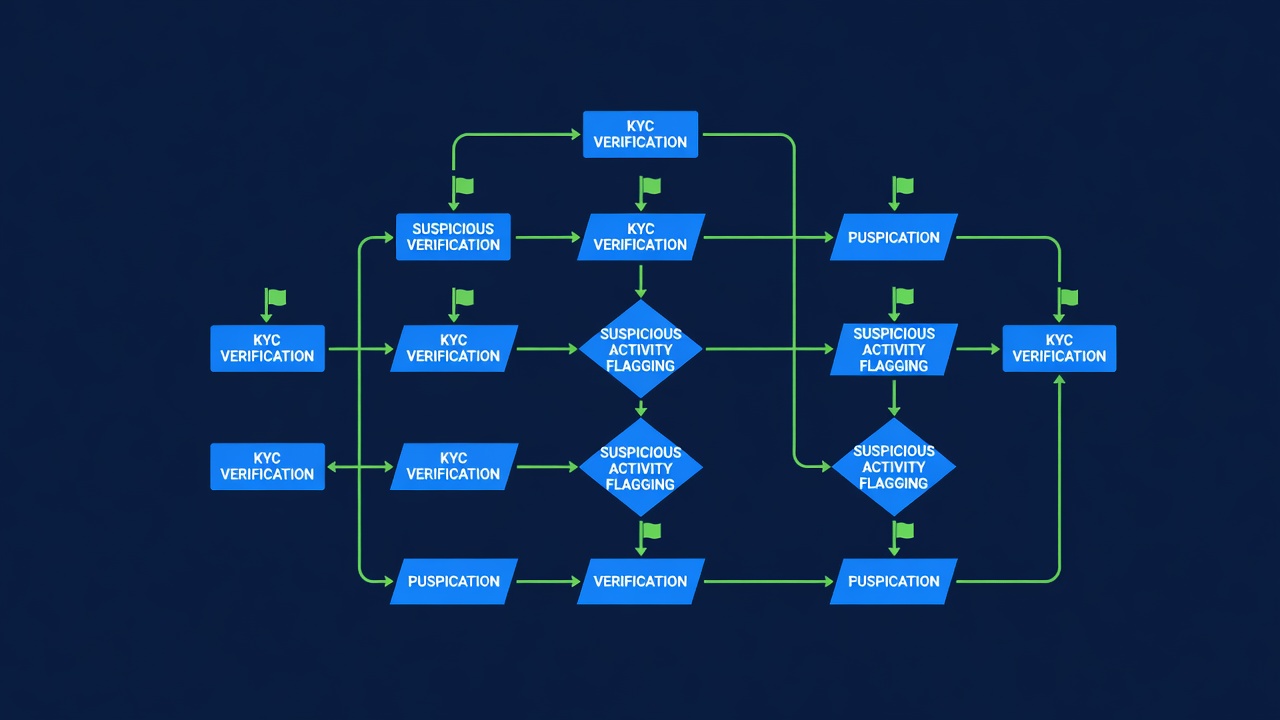
FINCEN, the U.S. Financial Crimes Enforcement Network, requires all casino operators to implement Know Your Customer procedures. This means: you provide identification, proof of address, sometimes source of funds. The casino collects this, logs it, stores it.
Why? Because money laundering relies on obscurity. A criminal needs to convert dirty money (proceeds from crime) into money that looks clean. Casinos have historically been venues for this: bring a duffel bag of cash, gamble it, cash out with chips. The casino shows the law it was a legitimate gamble.
The AML architecture kills this by requiring that the money flowing in must be connected to a known person, and that the pattern of play must be logged.
The Cryptocurrency Problem
Crypto gambling presents a structural challenge to AML. Blockchain transactions are pseudonymous, not anonymous, but the pseudonym doesn't map to a name. A wallet address doesn't tell you who owns it. So a crypto casino faces a gap: how do you implement KYC when the deposit can be theoretically untraceable?
Regulated crypto casinos solve this differently depending on jurisdiction. The MGA (Malta Gaming Authority) requires: identify the customer before allowing withdrawal. Some operators go further and require identification before deposit.
Unregulated operators and offshore jurisdictions sometimes impose looser standards. Curacao eGaming, which licenses many crypto casinos, has less stringent KYC requirements than the MGA. This creates an arbitrage: want to use crypto to gamble with weaker identity verification? Go to Curacao-licensed sites.
How the Rules Actually Work
A legitimate crypto casino takes your Bitcoin deposit. It knows your wallet address, not your name. It allows you to play with the funds. If you want to withdraw and it's over a certain amount (usually ten thousand dollars or its equivalent), the casino must verify your identity.
This is the pressure point. You can deposit anonymously. You can gamble anonymously. But you cannot withdraw anonymously without creating a Suspicious Activity Report that goes to FINCEN.
Once you're verified, the casino logs the connection: wallet address linked to your real identity. Future deposits from that wallet are connected to you. The architecture is now complete. The casino sees the flow.
The Architectural Trick
Like the casino floor without clocks, the AML system uses friction strategically. Deposit: no friction. Withdraw: high friction if you're trying to avoid identity verification. The design pushes you toward compliance.
A player trying to launder money through crypto gambling hits the friction point at withdrawal. They can get funds in. They can't get them out without revealing who they are. If they try to dodge it, the casino files a SAR and they've got a federal paper trail.
For legitimate players, the friction is just a form. You verify once and you're done.
Regulation By Jurisdiction
Malta's MGA has required full KYC before any activity as of 2021. This means verify before deposit.
Curacao eGaming allows some operators to defer verification to withdrawal. Cheaper for operators, riskier for AML.
The UK Gambling Commission requires verification before any activity, and ongoing monitoring of transactions for unusual patterns.
Singapore's MAS prohibits crypto casino operations entirely within Singapore's jurisdiction, though they license some regional operators.
This creates a landscape where crypto casinos migrate to the most permissive jurisdictions. A casino licensed in Malta is more strictly supervised than one licensed in Curacao. This shapes where unscrupulous operators go.
What Isn't Covered
Peer-to-peer crypto gambling isn't regulated the same way. If you and I agree to play poker using Bitcoin, with no intermediary, there's no AML requirement. But the moment there's a platform, a house taking a rake, it's a business. Regulation applies.
Unregulated casinos and so-called "provably fair" blockchain casinos that take no identity information operate outside the AML framework entirely. They're technically not legal in most jurisdictions. They operate on the assumption that enforcement is difficult and prosecution is rare.
The Bigger Architecture
AML in crypto gambling is really about control. The system works because: deposits are hard to hide (they're on a blockchain, which is auditable), withdrawals require identity verification, large transactions are monitored, and casinos that don't comply face license revocation and fines.
It's the same architecture as a Vegas casino without clocks. Control the information. Channel the flow. Make sure nothing happens outside the system.
For a legitimate player, AML is just bureaucracy. For someone moving dirty money, it's a barrier they can't cross without getting caught.