
Desk story / Blackjack
How Card Counting Works in Blackjack (and Why It's Harder Than You Think)
Card counting is not what Hollywood shows. I've traced the actual mechanics, the obstacles, and what happened to the MIT teams who tried it. The story is more subtle than the myth.
- Filed
- Byline
- Jerry Boyd
- Length
- 784 words, about 4 minutes
- Copy ID
- SM365-538574D2
The Quiet Night in Atlantic City
February 1979. A man in his early forties walks into Resorts International Casino in Atlantic City. He carries no visible equipment. No hidden computer. No cue in an ear. He is alone.
Over six hours, he wins seventy thousand dollars playing blackjack. The pit boss notices. The surveillance team notices. By the end of the night, the casino has photographed him, tracked his every hand, and cross-referenced his betting patterns against their internal database. They see what they fear: someone is beating the game.
They can prove nothing. The law permits him to play. So he leaves, seventy thousand dollars richer, and they are left knowing only that something happened in their casino that should not have happened.
This is how card counting actually works. Not with tricks. With math.
The Mechanics Are Simpler Than You'd Think
A standard deck has cards: four of each rank from ace to king. Remove those cards from circulation, and the composition of the remaining deck changes. The ratio of high cards to low cards shifts.
Blackjack depends on this ratio. When the deck is rich with aces and tens (ten-value cards), the player gains an edge. The player can hit on stiff hands more safely. Blackjacks hit more often. The dealer busts more often on sixteen and seventeen. So if you know the deck is rich in high cards, you can increase your bet and take advantage of that temporary edge.
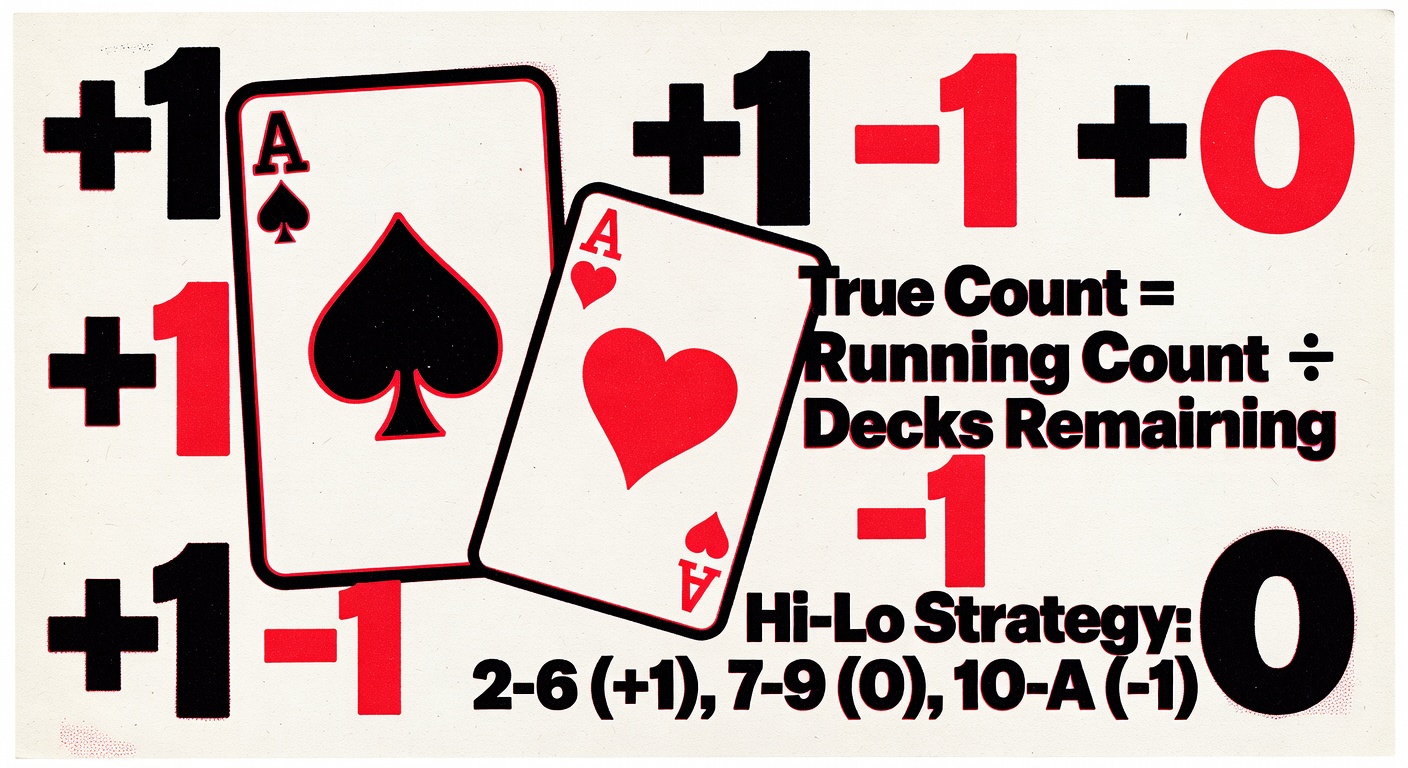
The method to track this is the Hi-Lo count, the simplest system that works:
- Cards 2 through 6: plus one
- Cards 7 through 9: zero
- Cards 10 through ace: minus one
As cards are dealt from the shoe, you track the running count. A running count of plus twelve means the remaining deck has twelve more high cards than low cards in its composition compared to a neutral deck. That favors the player.
Then you convert the running count to the true count by dividing by the estimated number of decks remaining. A running count of twelve with six decks remaining is a true count of two. True count of two: modest edge. True count of six: significant edge.
Why It Is Harder Than The Formula Suggests
The theory is simple. The execution is not.
First: you must maintain the count while two things are happening. One, cards are flying at you at a rate of sixty to eighty hands per hour. Two, the casino is working against you. A trained floor person or a surveillance team watches for exactly this behavior. They watch for:
- Betting that correlates suspiciously with remaining deck composition
- Betting that jumps from minimum to maximum on particular shoes
- Facial expressions that show computational work
- Conversation that stops and starts unnaturally
The advantage of counting, when you achieve it, is modest. True count of four gives you about one percent edge over the house. You need to preserve that edge for hours. Miss a single card due to distraction, and your count drifts. Your edge evaporates.
Second: the casinos fight back. Since 1962, when the Stanford professor Edward Thorp published "Beat the Dealer" and the MIT teams began their experiments, casino management has shifted every rule against the counter:
- Deeper penetration of the shoe before reshuffling became unthinkable (now many casinos cut off sixty percent of the deck)
- Continuous shufflers eliminate the composition changes entirely
- Barring is legal: a casino can ask you to leave, refuse your play, ban you forever
- Multiple-deck shoes became standard (harder to get a true count advantage with eight decks)
- Reduced blackjack payouts (six-to-five instead of three-to-two reduces the value of every edge you find)
The MIT Story Teaches Us
In the 1980s and 1990s, teams of MIT students, coordinated by investors, descended on Las Vegas, Atlantic City, and other markets with carefully trained counters. The largest team, which became the book "Bringing Down the House," won millions before being identified and scattered.
They were brilliant students at an elite school. They had training, discipline, bankroll, and a mathematical system that worked. They still got caught. The casinos used facial recognition. They used shared databases across properties. They used security professionals who had spent careers learning to spot exactly these teams.
The last major count team with significant success was shut down by 2000. The barrier to entry became too high. The casinos had adapted.
Card counting works. It simply requires months of practice, mental discipline that cannot be broken under stress, a bankroll large enough to weather variance, cooperation with teammates, and an acceptance that you will eventually be identified and barred. Most people find this arithmetic impossible.