
Desk story / Blackjack
How Card Counting Works in Blackjack (and Why It's Harder Than You Think)
The MIT card counters made it look simple. It wasn't. A dealer in Reno explains the mechanics, the math, and why casinos have spent forty years evolving their defenses.
- Filed
- Byline
- Bri Sutton
- Length
- 593 words, about 3 minutes
- Copy ID
- SM365-4DBD2891
February 1979. Atlantic City. A dealer named Frank stood at Table 12 in a casino that would later collapse into bankruptcy. A young man with sharp eyes had been playing for three hours straight. Buying in with small stacks. Doubling down at precise moments. Then leaving.
The next week, the same man returned. Same pattern. Different times. The casino had a problem, and they didn't quite understand it yet.
Card counting is not cheating. This matters. It's a mental skill applied to publicly available information. Nothing illegal about it. Casinos ban it anyway, which is also legal. They can refuse service to anyone for any reason.
The Mechanic
A standard deck has 52 cards. The house wants high cards, because a player hitting 16 against a dealer's 6 is desperate and incorrect. The player wants low cards, because those same hands become standable. A 16 against a 6 when tens are gone is a surrender, not a gamble.
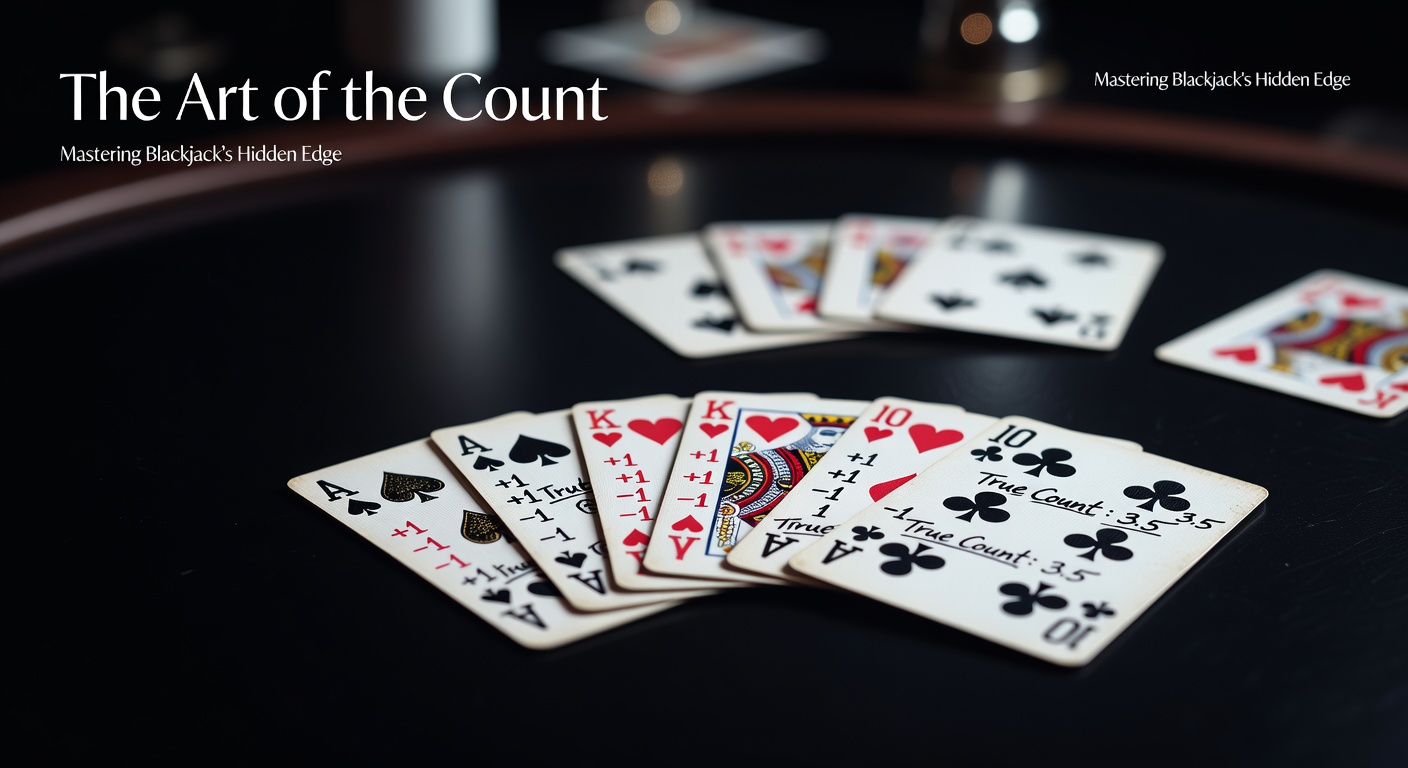
Card counting works by tracking the ratio of high to low cards remaining. The simplest system assigns values.
Cards 2 through 6 are plus one. They help the player.
Cards 7, 8, 9 are neutral.
Cards 10 through Ace are minus one. They help the house.
You keep a running total throughout a shoe. When the count is high, you increase your bets. When it's low, you minimize them. That's the entire strategy.
The card counter is not trying to predict the next card. They are adjusting their bet size based on probabilities the casinos acknowledge exist.
Why It's Harder Than Hollywood Shows
The MIT blackjack team made card counting famous, but they showed only the end result. What they didn't show was the grind.
First problem: you must play long-term. A single shoe is not enough evidence. Sixteen hours at a table. Minimum bets on cold shoes. Big bets on hot shoes. The variance is real. You can count perfectly and still lose five thousand dollars in a session.
Second problem: counting in a noisy casino with a dealer changing every twenty minutes is not the same as counting in your bedroom. Mental fatigue breaks you. After six hours, you make mistakes. Not major ones. Small errors in tracking that compound across a shoe.
Third problem: casinos adapted. They now use continuous shufflers on some tables, which makes counting useless because the deck never gets significantly depleted. They reduce deck penetration. They rotate dealers more frequently. They use multiple decks in a single shoe.
Don Smith ran blackjack at the Golden Nugget in Las Vegas from 1986 to 1994. He estimated that true card counters represented perhaps two percent of serious players. The others thought they could count and couldn't.
The counting team that wins money is patient. They lose small and win big. The amateur counter gets bored on the third hour of flat-betting on a negative count and pushes chips into a two-deck shoe with three high cards removed.
The House Advantage After Counting
When card counting was actually popular, a perfect counter against a decent penetration had maybe a 0.5 percent edge against the house. Slim. They had to win through volume and discipline, not insight.
Today, that edge is nearly gone. The casinos have won this arms race.
Casinos banned Mike Aponte in 2003. He was a legitimate advantage player. He had the math perfect. He lost anyway, eventually. Time and variance ground him down.
The card counter was never the criminal mastermind. They were a mathematician with patience and a bankroll. The casinos made sure that's no longer sufficient.