
Desk story / Blackjack
Why Continuous Shuffling Machines Kill Most Advantage Plays
A continuous shuffling machine processes cards immediately after play and reintroduces them into the deck. The effect on card-counting advantage is total.
- Filed
- Byline
- Nina Frost
- Length
- 719 words, about 4 minutes
- Copy ID
- SM365-6593BDD6
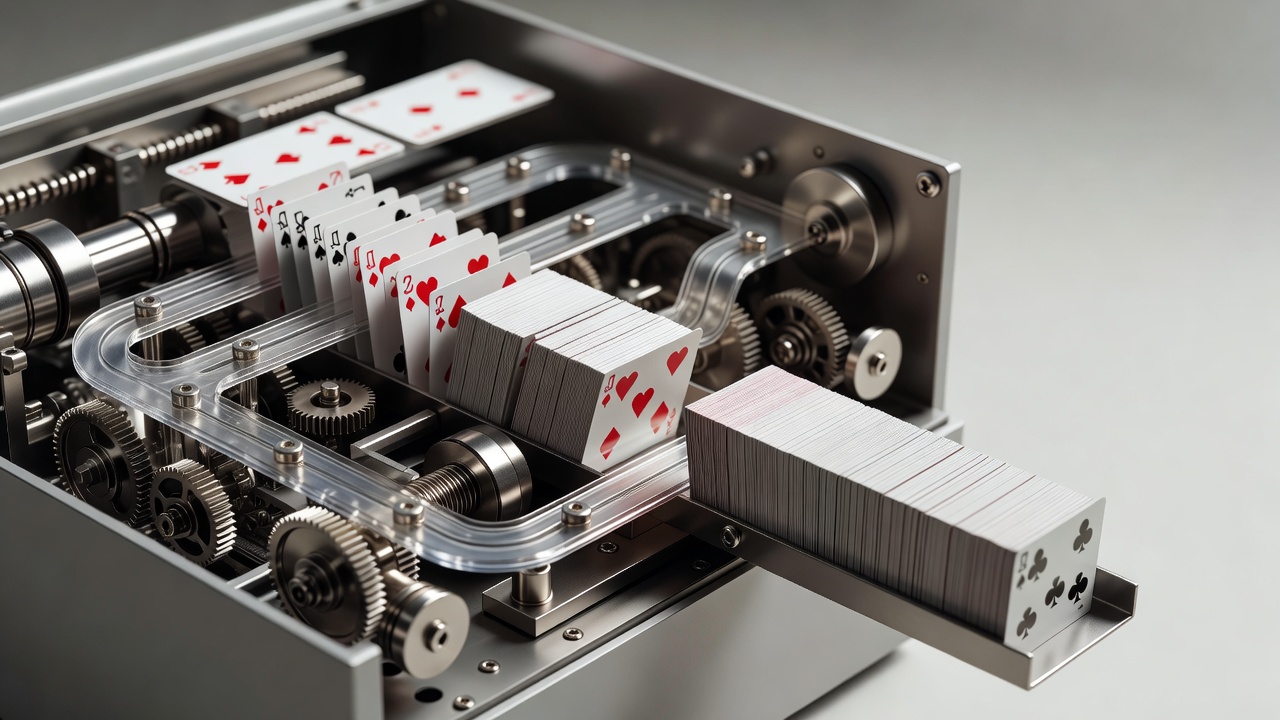
The continuous shuffling machine is a device that addresses a specific regulatory concern: the ability of players to gain advantage through card counting. The device operates by removing cards from the discard pile immediately after each hand and returning them to the shuffler, which maintains the deck in a constantly randomized state.
To understand why this device eliminates advantage plays, one must first understand what card counting accomplishes. Card counting, specifically in blackjack, is a technique by which a player tracks the ratio of high cards to low cards remaining in the deck. When the remaining deck contains an unusually high proportion of high cards (tens and aces), the player's advantage increases because blackjacks become more likely and certain plays (like doubling down) become more profitable.
Card counting is mathematically valid. It is a valid analysis of probability given information. However, it requires memory. The counter must remember which cards have been played. The continuous shuffling machine eliminates the information advantage. By returning all cards to the shuffler after each hand, the machine ensures that the deck composition is always random, always the same as the initial composition.
The Mechanism and Its Effect
Consider a standard blackjack game. The dealer works from a shoe containing six decks (312 cards). In a traditional game without continuous shuffle, the dealer plays until approximately 75 percent of the cards are exhausted, then reshuffles. During this play, the composition of the remaining deck drifts. If many low cards have been dealt, the remaining deck is rich in high cards. A counter would increase their bet.
With a continuous shuffler, the situation changes. The discard pile (the cards that have been played) are immediately returned to the shuffler. From the player's perspective, the deck has been shuffled after each hand. This is mathematically equivalent to playing with a fresh deck every hand. The advantage from counting is eliminated.
The return to the shuffler happens quickly, typically within seconds. This means the counter cannot accumulate information about the deck's composition because the composition is reset continuously.
The Regulatory Context
Continuous shuffling machines were introduced in the 2000s. They were developed in response to the popularity of card-counting books (most notably "Beat the Dealer" by Edward Thorp, published in 1962, and "Bringing Down the House" by Ben Mezrich, published in 2002). Casinos recognized that players had access to information about how to gain advantage. The continuous shuffler was the technological solution.
The Malta Gaming Authority permits continuous shufflers in blackjack games. The UK Gambling Commission permits them. The reasoning across jurisdictions is consistent: the device removes an unfair advantage. A player using a counting strategy cannot gain edge against a continuous shuffler because the information required for the strategy is not available.
Advantage plays other than card counting are also affected. Shuffle tracking (predicting where specific cards will be after the shuffle) is eliminated because the shuffling is continuous. Ace sequencing (tracking the location of aces and adjusting play accordingly) is eliminated. Any strategy that requires knowing the future composition of the deck is rendered ineffective.
The Remaining Advantage Plays
Some advantage plays persist even with continuous shufflers. Hole-card play (seeing the dealer's hole card and using that information) remains possible, though it is actively defended against by casinos. Dealer tells (noticing patterns in how the dealer plays) might persist, though trained dealers are taught to avoid tells. And plain superior play (understanding basic strategy better than the house expects and playing consistently) continues to be the only sustainable advantage.
The continuous shuffler thus serves a regulatory purpose: it ensures that the game of blackjack cannot be beaten through information advantage. It can still be beaten through superior understanding of probability and correct decision-making, but this advantage is small (around 0.5 percent for a perfect basic strategy player).
For casinos, the continuous shuffler also accelerates play. With reshuffles taking time in traditional games, a shuffler that operates during play increases hand-per-hour metrics. The device therefore serves both a regulatory purpose and an operational purpose.
The substantive point is this: the continuous shuffler represents a regulatory choice. The choice is that games should not be beatable through information advantage. All jurisdictions that regulate blackjack with this device enforce the same principle. A player who understands why the device exists understands why their advantage-play strategies will not work.