
Desk story / Live Casino
Live Roulette Strategy: The Truth About Betting Systems
Roulette betting systems promise to beat the wheel. They don't. But understanding why reveals how games are designed to fail you.
- Filed
- Byline
- Jerry Boyd
- Length
- 767 words, about 4 minutes
- Copy ID
- SM365-E1C69E4C
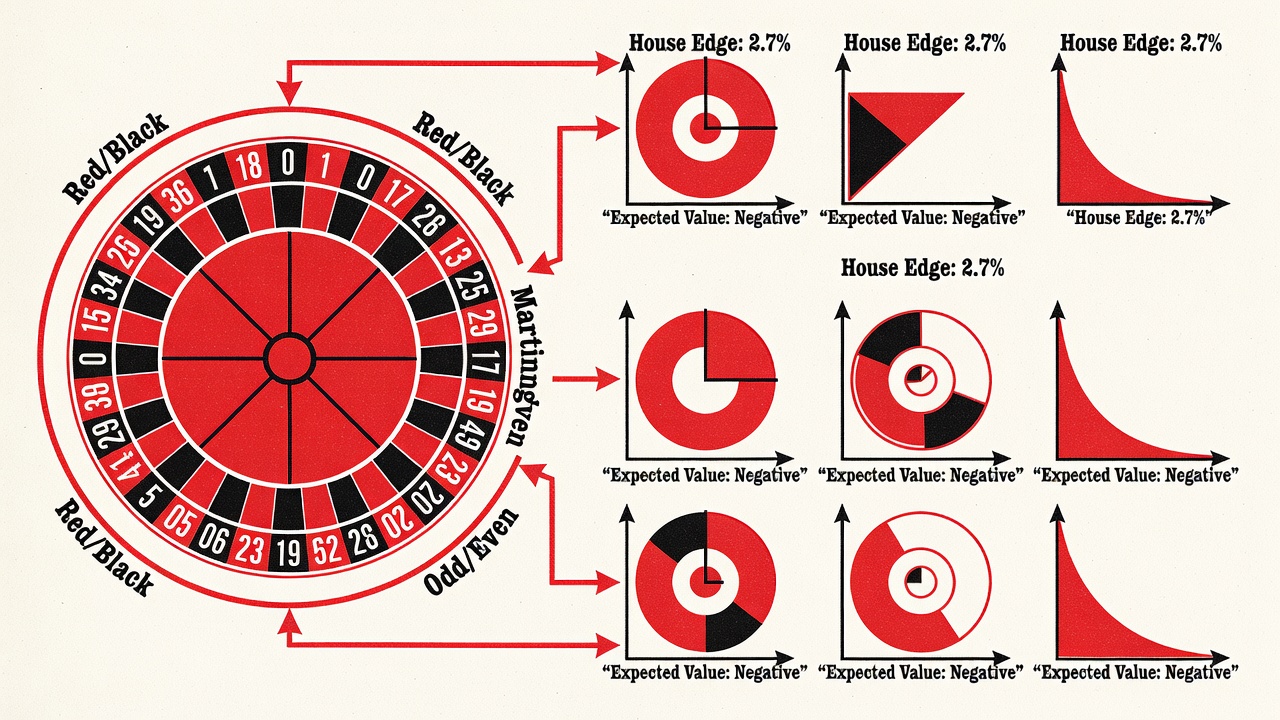
Every roulette betting system operates on the same false premise: you can beat a game of pure chance by managing your stakes cleverly. The Martingale, the Fibonacci, the Labouchere. All versions of the same dream.
The dream goes like this: if you double your bet after every loss, you'll eventually win and recover everything. Or if you bet in a sequence that builds toward wins, the wins will cover all the losses. Or if you play "sleeping numbers" that haven't hit in a while, they're due.
They're all wrong. But the reason they're wrong reveals something about how games are designed.
The Martingale Illusion
From a systems-design perspective, the Martingale is interesting. It's a negative-feedback loop. You lose, you increase your bet. You keep increasing until you win. Psychologically, it feels like you're punishing the game. You're showing it you won't be beaten.
But roulette has no memory. Every spin is independent. The wheel doesn't care about your betting sequence. And the math doesn't work either: eventually you hit table limits. Once you're betting the maximum allowed, you can't double anymore. Now you're trapped. You've lost, say, four in a row. You're betting five hundred. You lose a fifth time. You're down three thousand. You can't escalate. You can only absorb the loss.
The system relies on infinite money and no table limits. You have finite money. The table has limits. The system fails.
Why People Still Believe
This is a retention hook. When a system "works," it works for a short time. You play the Martingale for twenty spins, win twice, think "this is real," and the feedback loop keeps you engaged. You're not playing roulette. You're playing the system. The system is the game.
That shift is the entire point. The house wants you focused on your betting strategy, not the actual odds. If you're counting sequences and managing stakes, you're in a different psychological space than if you're simply spinning and losing.
Live dealers amplify this. The dealer asks for your bet. You place it. The wheel spins. The ball lands. The dealer announces the result. You're not just gambling. You're performing a ritual. The ritual feels like control.
The Design Angle
Live roulette platforms deliberately allow extended sessions where systems feel viable. A smart operator knows that a player running a system will stay longer, lose more, and return more often than a casual spinner.
So they: Offer betting tools that calculate sequences for you. Show your bet history so you can evaluate how your system is performing. Allow rapid-fire spins so you can run through sequences quickly without thinking. Add banter from dealers that validates your focus on strategy.
The game itself is unchanged. House edge is still 2.7 percent on European wheels, 5.26 percent on American wheels. But the presentation makes you feel like you're executing a plan.
What Actually Beats Roulette
Nothing. Not systems. Not patterns. Not luck. The house edge is built into the physics of the wheel and the geometry of the ball. No betting sequence changes that. The probability of red on a European wheel is 48.6 percent. That's true regardless of how many times black has hit.
The closest thing to an edge is a biased wheel: a wheel that physically favors certain numbers. But modern wheels are engineered to eliminate bias. And casinos test wheels constantly for drift.
Beyond that, there's nothing. Every betting system is a way to manage losses psychologically. It makes you feel like you're in control. You're not.
Why the House Permits This
The house permits systems because systems keep players engaged. A player running a system stays longer, loses more overall, and returns for more sessions.
If everyone just spun randomly, hitting and leaving, the house would make less money per player. Systems create retention. They create narrative. They create the feeling that you might crack the code.
From a game-design perspective, permitting and even promoting systems is genius. The game itself is impossible to beat. But the illusion of beatability keeps the game alive.
The Real Strategy
If you're going to play roulette, know that you're paying for entertainment at a 2.7 to 5.26 percent cost. Set a budget. Treat it as the price of the experience, not an investment. Don't run systems. Don't chase sequences. Don't believe in the next spin being different from the last.
Or don't play at all. That's also a valid strategy and it's the one that statistically performs best.
You can't beat roulette. The house designed it that way. Your betting system is just a way of telling yourself a story about losing.