
Desk story / Live Casino
Martingale System in Live Roulette: Why It Eventually Fails
You double your bet after every loss. Eventually you win and recover everything. That's the theory. The reality has two problems.
- Filed
- Byline
- Bri Sutton
- Length
- 674 words, about 3 minutes
- Copy ID
- SM365-CC1FAC9E
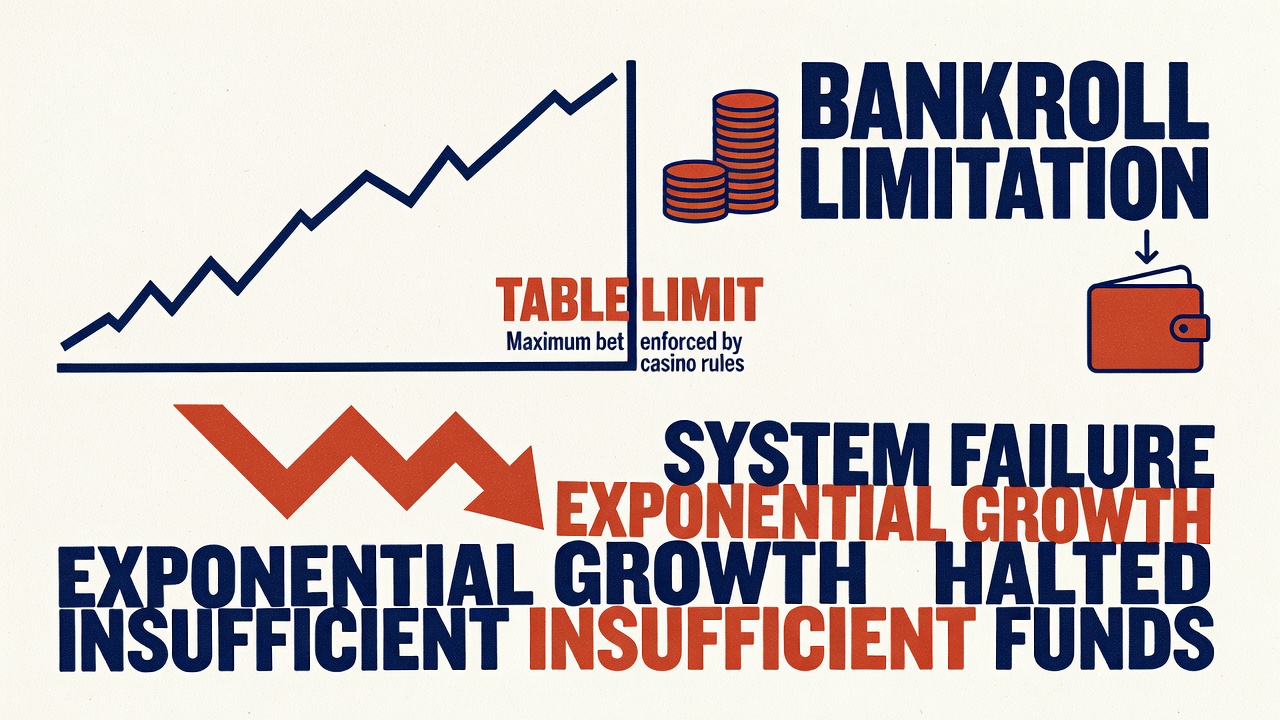
The Martingale system is a negative-progression betting strategy. You start with a base bet. If you lose, you double the next bet. You keep doubling until you win, which resets you to the base bet.
The Theory
Suppose you bet $10 and lose. You bet $20 and lose. You bet $40 and lose. You bet $80 and win.
You've wagered $10 plus $20 plus $40 plus $80 equals $150. You've won $80. Your net is negative $70.
Wait, that doesn't look right. Let me recalculate.
You've lost $10. Lost $20. Lost $40. Won $80. The $80 win pays you even money, so you get $80 in return plus your original $80 stake back.
Your net result across all four bets: lose $10, lose $20, lose $40, gain $80 minus $80 (your original bet), net positive $10.
So you win your original base bet amount every time you complete the sequence.
That's the appeal.
The Reality
Two problems kill the Martingale.
First: table limits. You can't double infinitely. A roulette table has a maximum bet, usually $5,000 or $10,000. Once you hit that limit, you can't escalate further. You're stuck.
If you've been doubling and you're at the limit and you lose, you lose the maximum. You can't make up the sequence. You're down thousands of dollars.
Second: money. You need exponential capital. Double once, you're betting $20. Double five times, you're betting $320. Double ten times, you're betting $10,240. Most players don't have that much capital to risk on a single sequence.
The Math
Roulette has a house edge. European roulette has 2.7 percent (48.6 percent probability of red or black, 50 percent probability to break even). American roulette has 5.26 percent (47.4 percent probability of red or black).
The Martingale doesn't change the house edge. Every bet has the same 2.7 or 5.26 percent expectation. The Martingale doesn't add a mystical edge. It just changes the distribution of wins and losses.
The Martingale creates a situation where you win small amounts frequently and lose large amounts rarely. But the expected value is identical to flat betting.
The Live Dealer Angle
Live roulette dealers don't care what betting strategy you use. They just spin and pay. The Martingale works the same on live as on automatic roulette.
But the psychological aspect is different. You're playing against a live dealer, on camera, in a room full of other players. The emotional impact of losing a $640 bet after escalating from $10 is different when someone else is watching.
Why People Try It
The Martingale feels like control. You're executing a plan. You're escalating strategically. When you eventually win, it feels earned.
But it's an illusion. The win doesn't come from executing the strategy. The win comes from the wheel landing on your color. The strategy just determines your bet size.
The Actual Risk
Most players fail the Martingale because they hit the table limit before completing a sequence and clearing their losses. The average Martingale player starts with a $10 base bet, plays for 30 minutes, escalates to the table limit on a losing sequence, loses $5,000, and quits.
The few who don't hit the limit and walk away with a $10 win feel like they've beaten the system. They haven't. They've just experienced lucky variance over a small sample.
The Alternative
Flat bet. Bet the same amount every spin. Your expected loss is the house edge times your total wagered. If you play $1,000 worth of spins at a $10 base bet, your expected loss is the house edge times $1,000.
Martingale or flat betting, the expected loss is identical. The only difference is the variance profile. Martingale has bigger swings. That's it.
The Closing
Martin Martingale is a betting strategy that creates an illusion of control and strategy. It doesn't change the underlying probabilities. It just changes when you lose.
When you eventually hit the table limit and lose everything on one spin, you'll remember the strategy didn't work. Until then, the small wins feel good.
That's exactly why the house permits it.