
Desk story / Slots
Reality Checks, Session Limits, and Loss Limits for Slot Players
The slot machine is a time-purchase mechanism disguised as a betting game. Understanding session limits means understanding what you are actually buying.
- Filed
- Byline
- Bri Sutton
- Beat
- SlotsRegulation
- Length
- 761 words, about 4 minutes
- Copy ID
- SM365-A2ECE16C
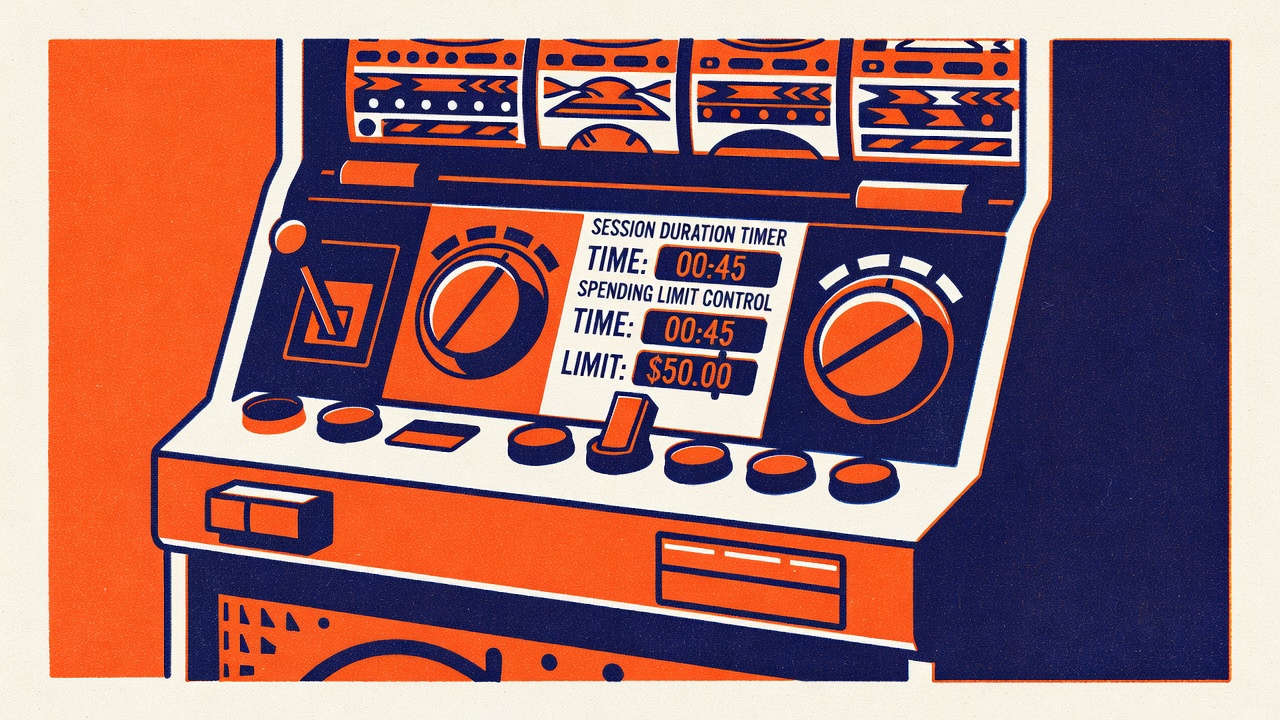
Consider what a slot machine is from a first-principles perspective. A person enters a casino with one hundred dollars and three hours of free time. The slot machine offers a trade: the person can convert both of these into something else (money remaining and time spent). The question that separates the recreational gambler from the person who is purchasing a problem is not whether this is a fair trade, but whether the person understands what they are trading.
Reality checks and session limits are tools that answer this question. They are not devices that make gambling "safer" in some moral sense. They are devices that make the trade legible. A reality check is a forced interruption. After thirty minutes or one hour, the machine displays a message: you have been playing for one hour. You have spent ninety dollars. Do you want to continue? The person now has actual information about the ratio of time to money.
Why this matters. The human sense of time is subjective, and the slot machine is designed to exploit this subjectivity. The absence of clocks, the continuous feedback of spinning reels, and the variable-ratio reinforcement schedule all combine to distort time perception. A person can sit down at six PM and believe it is six-thirty when it is nine. They have lost three hours. The loss of time and the loss of money have become entangled.
Loss limits work differently. A loss limit says: you can lose, at most, one hundred dollars in this session. Once you reach that limit, the machine stops. You cannot play further. This is a tool that makes one's time-preference legible. The person is saying, "I want to spend some time in a casino, and I am willing to accept a certain amount of loss as the price of entry, but not beyond that." This is rational behavior. The problem occurs when people do not pre-commit to a loss limit and instead adjust it in real time based on their emotional state.
The Austrian school of economics is interested in subjective preferences and the choices people make under uncertainty. A slot player has a genuine preference for the experience of slot play: the sound, the possibility, the narrative arc of a session that might end in a win. This preference is not less legitimate than a preference for opera or hiking. What is legitimate is the mechanism for discovering and honoring that preference.
How Session Limits Work
Most licensed casinos now offer session limits. You log into your account and set a time limit: one hour, two hours, or a custom duration. When the time elapses, the system logs you out. You can log back in, but the friction of re-entry creates a moment where you can reconsider. Some casinos offer reality checks: every fifteen minutes, a notification. Some offer automatic time-outs where you are required to wait before playing again.
The effectiveness of these tools depends on whether people actually use them and whether they honor their own prior preferences when they feel like changing them. A person who sets a loss limit of fifty dollars in a rational moment and then raises it to two hundred dollars in an emotional moment has not changed the mechanism. They have changed their preference. The tool is only as good as the decision-making in the moments when it is being set.
This is where the concept of discount rates becomes relevant. An economist would say that a slot player values immediate entertainment more than future solvency. They are willing to exchange one for the other. This is not irrational. What is irrational is being surprised by the exchange later. A session limit makes the exchange explicit in advance.
Loss limits matter because they solve a specific problem: present bias. The subjective value of playing now exceeds the subjective value of not playing later. When you are sitting at the machine, the marginal utility of one more spin is high. When you are not sitting at the machine, the marginal value of the money you spent is high. These valuations are incompatible. Loss limits force a decision when the two valuations might be in better alignment.
The regulated casinos that offer strong session limits and reality checks are solving an economic problem, not a moral problem. They are saying: we will make the trade legible. You can still make the trade. You will know what you paid for. Operators who resist these tools are claiming that people should not be forced to see what they are buying, which is a revealing claim.