
Desk story / Guides
How to Tip a Live Dealer and Why Etiquette Matters
The dealer brings cards. You win. Now what? The tipping question is really a question about what you think you're paying for.
- Filed
- Byline
- Cole Hastings
- Length
- 566 words, about 3 minutes
- Copy ID
- SM365-99AFC403
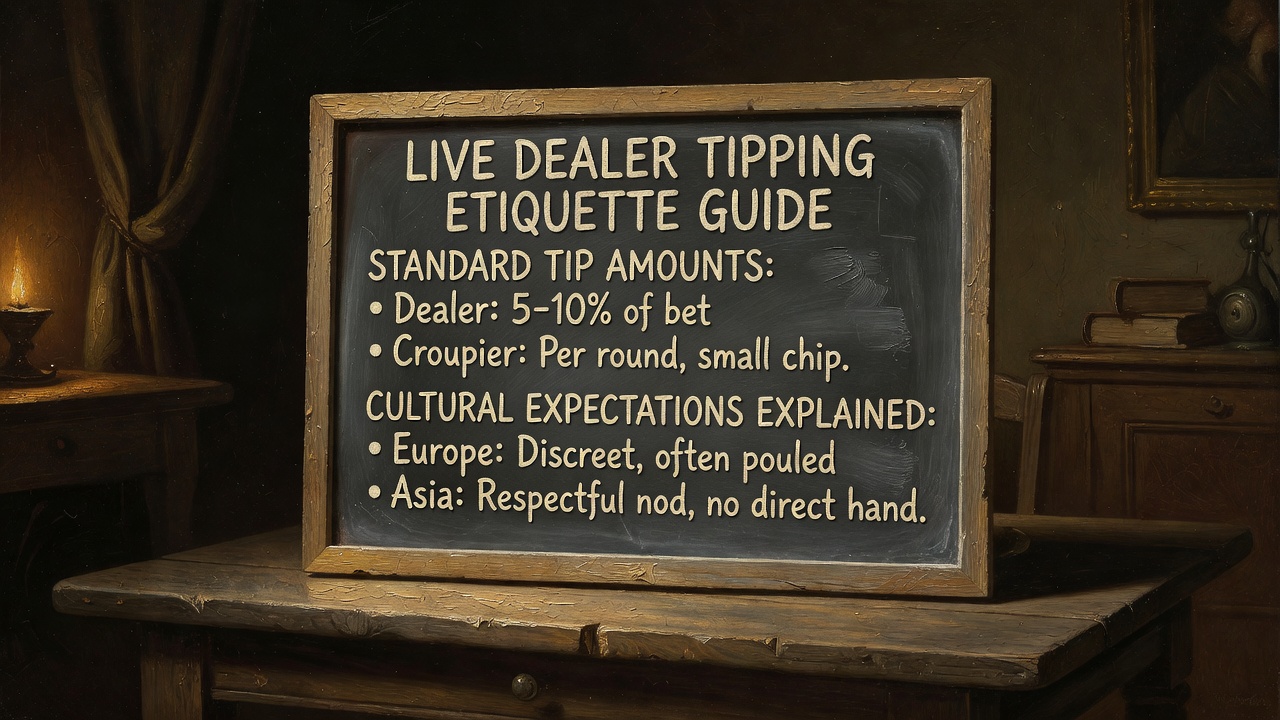
At a live baccarat table, you win twenty hands. A hundred. Five hundred. The dealer's smile never wavers. You're up two grand. You leave the table. Do you tip the dealer? How much?
The honest answer: not as much as the casino wants you to.
The Mechanism
Tippers in live casinos usually toss a chip. Could be a dollar. Could be ten. The amount varies by region and game. In Las Vegas, the norm is roughly one percent of the win. In Macau, higher. Online live casinos often display an optional tip button at 5, 10, 15 percent.
What's actually happening is straightforward: the house collects tips from all players, pools them, and distributes them to the dealers. The dealers are often contract workers, not employees, so tipping pads their income when the house doesn't. This is not an ethical innovation. It's a cost transfer. The house pays dealers less base salary and lets the players make up the difference.
The Psychology Layer
The live dealer industry has spent years studying how to make you tip. The casino itself does something clever: it asks the software to display the tip option after every win. The timing matters. You won. You're in a good mood. The friction is almost zero. Click the 10 percent button. Done.
Some platforms are more aggressive. FanDuel's live tables show tip percentages. DraftKings frames it as a choice. Some overseas operators don't show the option at all, which is honest. Others make it hard to decline: the button is small, or requires two clicks.
Behavioral economics has a term for this: "choice architecture." The way the option is presented changes behavior. A ten percent button labeled "Generous" gets more clicks than one labeled "Standard Tip."
The Honest Accounting
Tipping is voluntary. That's the rule almost everywhere. But the word "voluntary" carries social weight. You won. The dealer smiled. Not tipping feels like being cheap.
Here's what the industry knows: most players don't calculate expected value on tips. They don't think, "I won $400. A 5 percent tip is $20. What did the dealer do to earn it?" They feel good about winning and hand over a dollar or two, or click the button.
If you do the math, the case for tipping weakens. The dealer doesn't influence the outcome (the RNG does). The dealer isn't taking personal risk. The dealer isn't choosing your cards. The dealer is reading a script and executing a function the house programmed.
The Nuance
That said, live dealers are often underpaid. Tipping at least acknowledges that reality. The question isn't really whether to tip. It's whether to subsidize the house's decision to pay its workers below-market wages.
If you can afford to tip without affecting your session bankroll, and you believe the dealer deserved good service, tip. If you're grinding a session, tracking variance, and every dollar matters, don't. The house won't judge you. They'll just retune the UI for the next player.
The Real Etiquette
Etiquette means treating the dealer as a person, not a tip receptacle. It means: follow the house rules. Don't be rude. Don't blame the dealer for bad cards. These things matter. Tipping is optional.
You're not required to subsidize the dealer's salary to be polite. The real etiquette is clarity. If you tip, tip because you chose to. If you don't, it's not wrong. It's just a different calculation of fairness.