
Desk story / Slots
The Psychology of Slot Design: Why Near-Misses Feel Like Wins
The near-miss effect is documented in behavioral gambling research. A slot player sees a winning symbol in two of three reels, misses the third, and experiences a measurable dopamine response. The game exploits a cognitive mechanism. Regulation addresses it imperfectly.
- Filed
- Byline
- Cole Hastings
- Beat
- Slots
- Length
- 676 words, about 3 minutes
- Copy ID
- SM365-BB29D8F3
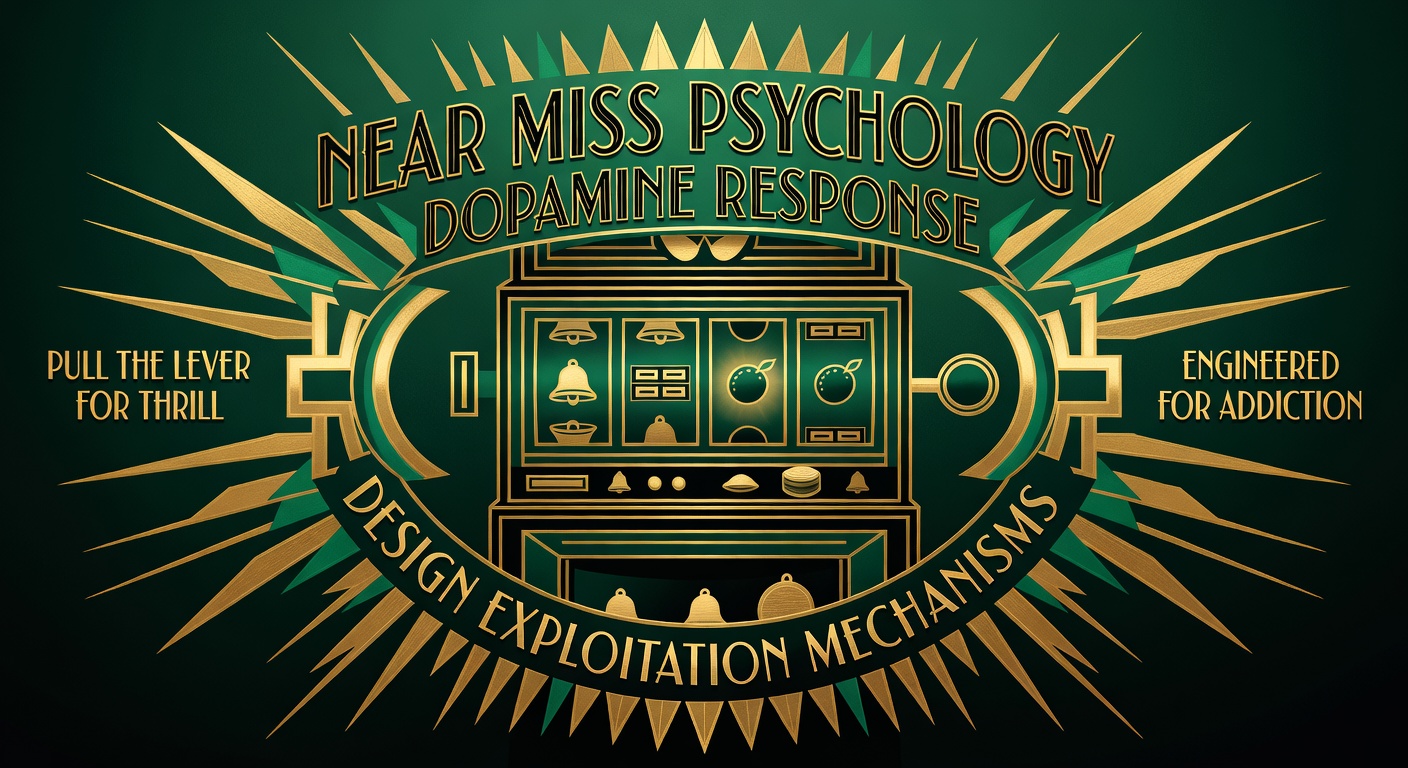
The European Gaming and Betting Association compiled data in 2018 on how slot designs affect player retention. The finding was consistent: games that produced near-misses held players longer than games that did not. A near-miss is a result where the player is close to winning but does not. Two cherries and then a plum, for instance, in a machine where three cherries wins.
The mechanism is psychological rather than mechanical. The RNG delivers a specific outcome. The outcome happens to be close to a winning configuration. The player perceives near-miss as evidence that the machine is "almost" paying. In fact, the near-miss is simply a lost spin that contains partial symbol alignment.
Research from the University of British Columbia (Sharpe and Tarrier, 2013) demonstrated through fMRI imaging that near-misses activate reward circuitry in the brain at nearly the same level as actual wins. The phenomenon is observable in neural tissue.
Design Implementation
Slot machine manufacturers, aware of the effect, design games intentionally to produce near-misses. A machine might be programmed such that when the RNG calls for a loss, the game presents that loss in a way that suggests near-winning.
The technical implementation is straightforward. The outcome (lose or win) is determined by the RNG. The symbols that display are then chosen to represent that outcome in the most engaging way possible. If the outcome is a loss, but a near-miss is possible, the machine displays near-miss symbols. If a near-miss would be disengaging, the machine displays symbols with no thematic relationship to winning combinations.
This is disclosed in gaming regulations in some jurisdictions. The Gambling Commission in the UK requires that operators explain the near-miss phenomenon to players in their responsibility messaging. Nevada gaming regulations, less explicit, do not mandate specific messaging about near-misses.
The near-miss is a design choice, not a mechanical consequence. It is chosen because it extends session length.
Measurable effects: players experiencing near-misses place subsequent bets larger than players who simply lose without near-miss framing. Players experiencing near-misses quit sessions later than control groups. The effect is consistent across jurisdictions.
The regulatory response varies. The UK has restricted near-miss prevalence in some categories of games. Certain restricted machines used in licensed premises must not produce near-misses above a defined threshold. Online operators in the UK must disclose near-miss frequency if applicable.
Other jurisdictions take a disclosure approach. Nevada requires that if a game uses near-misses, the term-of-service must explain it. The disclosure shifts responsibility to the player to understand the mechanic. This is the lighter-touch regulatory approach.
Arguments for restricting near-misses: the effect influences vulnerable populations disproportionately. Problem gamblers experience stronger dopamine response to near-misses than recreational players. The design choice, therefore, targets the population least able to regulate their behavior.
Arguments against restricting near-misses: the player chooses to engage with the game. Explaining the mechanic is sufficient. Additional restrictions constitute paternalism. Operators should have freedom to design within regulatory bounds.
The Practical Situation
A slot player in the UK encounters a game displaying two lucky sevens and then a wild. The player registers the near-miss and feels the pull of almost-winning. The game has been designed for this feeling. The near-miss is not incidental. It is the product.
The same player, if playing in Nevada, might encounter different near-miss prevalence. Nevada permits near-misses. The regulatory body has chosen not to restrict them. The player might encounter more near-miss sequences in Nevada slots than in UK slots.
Measurably, this affects behavior. Players exposed to more near-misses place longer sessions and higher bets. The design choice, therefore, has direct revenue implications.
The question regulators face is whether this design choice exploits a cognitive bias in a way that should be constrained. The near-miss effect is no more manufactured than many other game design choices. Flashing lights, celebratory sounds, animation delays, all of these influence behavior.
The near-miss is distinct because it specifically exploits a disconnect between perception and reality. The player perceives near-winning as statistically proximal to winning. It is not. A near-miss is a loss. The proximity is visual, not probabilistic.